Two Blankets and a Bed
May 2026 newsletter
Kia-Beth Bennett
6/14/202610 min read
A few farm updates, before the meat of the newsletter:
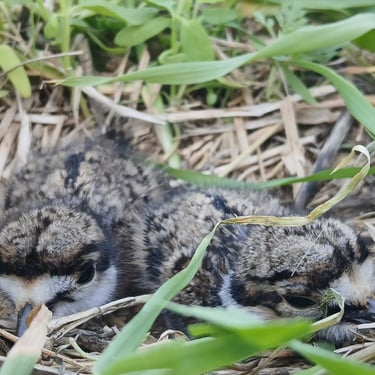
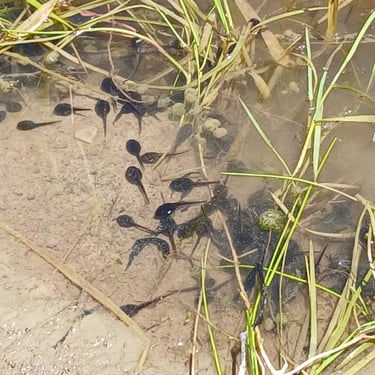
We’re full-tilt into baby season. The phoebes in the wellhouse are getting their fuzz, the juvenile robins are hopping around the viburnum, the bobolink and blackbird nests in the cow field are marked to avoid trampling, and the killdeer chicks are skittering around on tiny legs, looking like tail-less versions of their parents. One litter of piglets has arrived and the tadpoles are turning the edge of the pond black with their numbers. The paper wasps are molding old angelica stems into geometric homes, laying tiny, clear-cream eggs. There’s a mother ermine hanging out at the barn and the most adorable skunk kits are in Greenhouse One.
We’re also in the midst of Spring harvest. There’s a bowl of greens on the kitchen table, a refrigerator of rhubarb and asparagus, and green onions and garlic in the oven, alongside one of the chickens Brian and I butchered during his visit last week. I’m thrilled to have begun dehydrating herbs for the livestock earlier than ever before, cutting or pulling swaths of lovage, angelica, lemon balm, stinging nettle and violets and laying them in Greenhouse One to dry for Winter.
For the second year in a row, the Solarium transplants struggled with a root-rotting fungus. The solution is a water-carried strain of Streptomycin, which, upon reaching the plants, forms a protective barrier around them. It also, unfortunately, took me a week to convince myself to just spend the money on it, and so we lost several peppers, tomatoes, and most of the basil plants. The basil I can reseed; the others, I am grateful I planted a few extra.
Despite my concerns about pasture health, I can confidently say that this season’s fields are the lushest, healthiest I’ve seen in five years. The rotational grazing is making an enormous impact, and for the first time, I’ve drawn two maps to keep track of where and when the animals are eating.
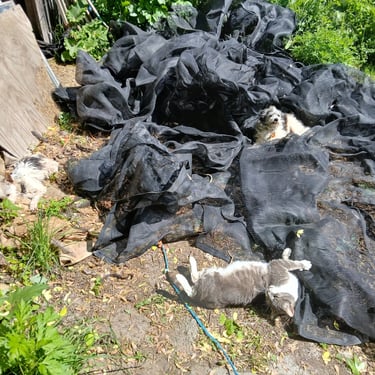
The cats have decided our life should be more like a picture book, so they’ve begun following me around the farm. I’m treated to adorable moments when Peter sprawls on his back in the blossom-filled garden, Milo balances on the pig-pen wall, or both of them sit looking up at me as I tend to the chickens in their new house.
We’ve been published! A reader reached out to me asking if they could include the April piece in The Whole Field, a bi-weekly newsletter from the Crosshatch Center for Art and Ecology in northern Michigan. It’s a really wonderful newsletter, and I’ve enjoyed reading other works included in their publication. Y’all should check it out!
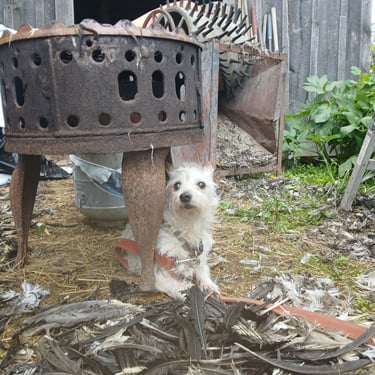
Geoffrey, my mother’s beloved terrier, has been diagnosed with inoperable lymphoma. We’ve chosen a quality-of-life path, so he receives daily steroids that slow tumor growth, increase his minuscule appetite, improve his energy levels and relieve pain. Having to take pills is almost worse than the cancer, in his opinion, but they’re doing their job. He still enjoys his daily routine (calm walks, passionate sunbathing, intense snuggles in blanket caves) and he seems in good spirits. Anyone who’s ever enjoyed Geoffrey’s friendship is welcome to visit.
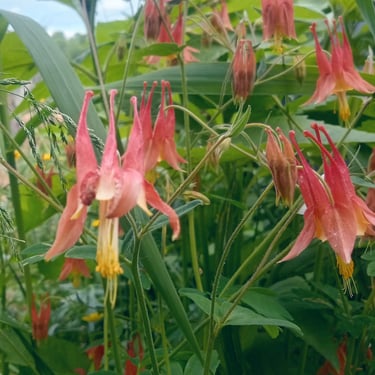
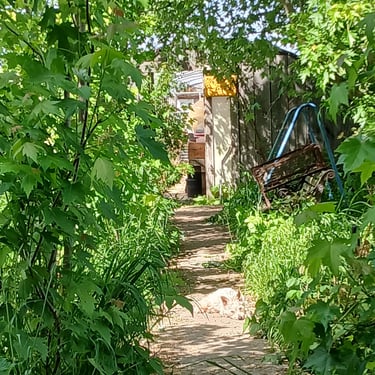
A gallery of photos from the farm, including a small dog, baby birds, cats and dogs lounging in the sun, native flowers, a verdant pathway to the greenhouse, and tadpoles.
Now for the main newsletter:
There’s a story I grew up with about my father’s family, a story that seemed to bleed into the rest of my familial interactions. In short, it’s been long decided that worry, panic and fear (worrypanicfear, to be precise) is woven into our genetic code, that we’re born with those vibrations constantly humming through our bones. I’ve been told point-blank that some members carry a conviction that catastrophes of all sizes, whether household or global, are their own, individual fault.
The thing is, observing my relatives over the years, I never really noticed a reason to disagree (about the intergenerational worrypanicfear, that is. 9/11 was not my family's fault). My grandmother was a champion worrier. My father reverts to panicking if the wind blows the wrong way. And I was, for better or worse, raised with a fear of ‘something’ going inevitably wrong. My mother would routinely threaten (and yes, I love my mother, but yes, there were some seriously concerning aspects of our dynamic) that “If you (Kia-Beth) go to town and the cows get into the road and are hit and killed, then it’s your fault.” To say that warning sank into my cells is an understatement - if I were to ever give birth, the child just might be a stunning example of epigenetics at play.
It took me until very, very recently to realize that villainizing my attempts to take time off was unfair and manipulative, and that escaping animals did not need to be an unsolvable, unpreventable, looming emergency. (I will take a moment to acknowledge that the BEST farm setup will never fully eliminate that possibility. Sometimes, a 400-pound boar is just gonna do whatever the heck a 400-pound boar wants to do. My heart goes out to those reading this while their sheep are squished into a garage corner with a scrap of plywood because they managed to clear the newly-stretched four-foot fence, and you're just too tired to handle them right now.)
The issue is that simply acknowledging the aforementioned facts is not enough. When your body is trained to worry, it doesn't just stop because you want it to. Picture a struck tuning fork - once hit, it keeps shaking, and shaking, and shaking, long after the resultant noise is undetectable by human ears. That's what it's like to live with ingrained, learned fear. Existing without it becomes a foreign concept, a vacuum you don't know how to fill. It's disorienting.
One might argue - correctly - that there's an entire planet’s worth of fear to feed right now. Trust me, I notice it every time someone mentions that it's 90°F in a USDA Zone 4 right now, or there's yet another military helicopter hovering above my house. But forced anxiety and unnecessary trauma are very different from the existential threat of and subsequent preparation for the climate crisis.
Let me paint a picture.
As long-time readers know, I try to get away around my birthday, which is May 7. I spend months planning a brief trip, trying to prepare multiple contingency plans. My birthday falls directly between the real end of Winter and the beginning of “Uh, yeah, no leaving the farm now, there are piglets coming and potatoes needing to be planted and corn needing seeding and, and, and…” season. Pausing for breath during that timeframe rejuvenates me so that I can cheerfully move into the busy season.
I thought I'd done an adequate job this year. I planned to be gone from 7 am to 9 pm on Saturday, May 2. I had three backup people on call, two students working that afternoon, and Jude and Murph would be on the farm, handling animal care and general maintenance. I’d finally obtained a phone that could make calls without wifi, and even a frustrating morning with the cows didn't deter me. I made it a whole 35 miles into a 134 mile trip when my phone rang.
It was Jude. Murph was experiencing a medical crisis; they were calling 911.
I couldn't decide between punching my windshield or sobbing. Eventually, I made a decision I do and do not regret: I turned around. Future me would realize this was unnecessary (wasn’t that what the backups were for?), but at the time, my body was shaking with anxiety. If I kept driving south, I reasoned, that would never stop. In my head, the ornery cattle were already loose, pigs were breaking fences, and the sheep were about to be eaten by coyotes. Ultimately, I spent the afternoon at the farm and the evening providing transportation to and from hospitals (Murph was eventually diagnosed with pancreatitis).
The next day I woke up crying. I wasn’t thinking as clearly as I’d have liked, but I hope I did the best I could. I called my backup people, one of whom was still free to do afternoon animal care. With her encouragement, I left at 8:38 am, holding myself together during a three-hour drive by talking on the phone.
Upon arrival at my destination - a friend's farm - I felt marginally better. I had a very nice time, but I spent a good portion of it wrapped up in my own head. Reasonable, but not as fun. The sun began to set, and I was asked if I was staying over for the night (my usual practice). I tried to explain why I couldn't - the cows, the hospital - I felt obligated to drive home. I was clearly exhausted, stressed, and my crash-related PTSD made driving through the mountains at night an incredibly bad idea, but I didn't know what else to do. The image of a bloodied cow and a destroyed truck kept flashing through my mind.
My friend (kindly) wasn’t having any of it. He handed me two blankets and a bed and said, “Don't leave until four.”
An hour later, I was on the phone, seeking advice and asking folks to check on the animals. And finally, I called Jude - who was still at the hospital - to explain I wouldn't be back until the next day.
I slept fitfully, but I rose with the sun. I shared a quiet morning with my friend, and left with a jar of delicious coffee. I drove an hour, stopped at another friend's house and stayed for a delightful breakfast of eggs, dandelion greens and conversation. I got home late, and I got to work.
Not a single thing I worried about had happened. My father would say that's because I did worry, and my worry prevented crisis. That's ridiculous. Worry without preventative action is the same as repeating ‘I love you’ and never showing up. It's hollow and empty, and it somehow manages to use up all the air in a room. The crises were kept at bay by socio-infrastructural supports. By Laurel, Cassie, Jeremy, Lyndsay, and Rick. The bone-deep fear was lessened by somebody else asking me to trust myself, the work I’d done, my neighbors and the judgement of my friends.
Now, we all know I can’t write a reflective essay without connecting to a bigger picture, so here goes.
The personal fear I’ve been describing is firmly rooted in family trauma, I realize. But let’s talk about the bone-deep, potentially unreasonable fears that, say, Americans are collectively taught to carry. Again, this isn’t about climate concerns, or whether your child will be disappeared by I.C.E. Those are, horrifically, very understandable things to worry about. But I find there exists in society a general anxiety over basic human interactions. There’s a hesitancy to reach out, to request or provide assistance. Hyperindependence is a mode of existence reinforced by a capitalist economy encouraging us to ‘climb to the top’, without any care for whom we step on as we do. Lessons in “Stranger Danger” make it easy for us to believe others are ‘out to get us’, which in turn causes more looking over our shoulders for imagined threats. I worry about loose cattle. An entire sector of the population worries about ‘dangerous immigrants.’
Perhaps it feels like a stretch to compare my agricultural anxiety to the mindset that’s brought about almost 300 deaths in national concentration camps in the last 23 years. The thing is, fear has a way of twisting our responses, making us do stupid things. Somebody constantly afraid of potential boogeymen might feel out of control. Their version of safety might narrow to only those whom they feel they can control, leading to power struggles, further manipulation, isolation and lack of trust, which heightens anxiety…It doesn't feel like a big leap to recognize that such a cycle could lead to the election and mass following of a fascist dictator, consequences be damned.
Knowing this, watching this - from here, where do we go? Fear compounding fear compounding fear has created rightfully terrifying global situations. Is it not bigger than me wondering if the sheep are in the road?
I mean, on the one hand, sure. I’m one farm with 18 sheep. On the other hand, I was convinced to relax because just one person willingly checked my animals when I asked. The socio-infrastructural supports on which I leaned (or was strapped to by force, take your pick) didn’t emerge from a vacuum; they were created - one sentence, one gift, one request, one relationship, one farm - at a time. Even when it’s an entire neighborhood, city, or country at risk, it’s those same individual bricks that lay the foundation for survival.
The world watched this Winter as the Twin Cities of Minnesota wore down an invasion of over 3,000 armed, militant federal agents. There were losses, to be sure, but there were also huge wins, made possible by ordinary civilians deciding, “You know what? I've never spoken to my neighbors before, but I'm going to offer to drive their children to school, so the kids aren't kidnapped.” The largest direct-action, anti-fascist uprising since the 2024 election was built with samosas. With fry bread. With teachers. With diaper drop-offs. With whistles and notebooks and handwarmers and thermoses of coffee. With strangers, to paraphrase author and activist Dean Spade, “…being brave enough to rely on each other.”
We don't all have to stand in front of cop cars, or burn warehouses. Some might, but that's not all it takes. Sometimes, it takes putting a toe outside your comfort zone, looking into someone's face, and saying, “Okay. I don't really know you, but I'm willing to try. I'm willing to trust.”
There's so much to be afraid of, and it’s getting worse. And I'm not going to say that things will just get better if we force-stop our anxiety. But much will be improved with preventative action, rather than constant worrying. I may never fully get over some of my ingrained fears, the way someone who's lived through war might always struggle with loud noises. But I'm bearing witness to something beautiful: a supportive community that helps me recognize when fear is appropriate, versus when it's taken over. And there are people for whom I can do the same.
So here's my hope for you, dear reader: that as you sit with your anxiety, someone sees your need. Someone hands you two blankets and a bed, or a gallon of gas, or a hug. We can each be a part of building communities resilient enough to overcome the very real terrors we face, and it starts with the small steps. I hope you can try to trust your neighbors, even if, at first, that just means trusting them to feed your cat. I hope you can accept a hand when in need. And I hope that someday, your network is connected enough that you can be simultaneously receiving and offering support, whatever that looks like, wherever you are.
Much Love,
Kia-Beth
she/her and zi/zir
If you enjoy these newsletters and want to support our work, consider subscribing on Substack! You can also become a paid subscriber, starting at $5 a month. Proceeds directly support the farm collaborative, our teaching and ecological efforts,.